Posts

Showing posts with the label financial accounting staffing

Internal Financial Control Over Financial Reporting

Image
Background Under Section 143(3)(i) of the Companies Act, 2013 (2013 Act) , an auditor of a company is required to state in his/her audit report whether the company has an adequate internal financial controls (IFC) system in place and the operating effectiveness of such controls. Explanation to Section 134(5)(e) of the 2013 Act defines IFC to include policies and procedures adopted by the company for ensuring orderly and efficient conduct of its business, accuracy and completeness of the accounting records, and timely preparation of reliable financial information. The Institute of Chartered Accountants of India (ICAI) had issued a Guidance Note in November 2014. This Guidance Note has been revised subsequently and the ICAI issued a revised ‘Guidance Note on Audit of Internal Financial Controls Over Financial Reporting’ (Guidance Note) on 14 September 2015. What is Internal Financial Control Over Financial Reporting? Internal Controls are to be an integral part of any organization’s fina...

Emerging Financial Accounting Trends 2022

Image
Technology is synonymous with development and modernizing the business landscape. Even in the pandemic state, Technology growth helps to transforms systems and processes, converting manual tasks into automated functions to operate businesses more efficiently and effectively. Latest accounting trends mainly revolve around this growth of automation and high-tech systems covering various accounting process that are being automated like approval workflows, bank reconciliation, journal entries, inter-company consolidation, revenue recognition, lease accounting and depreciation. The financial accounting trends are not just about processes, digital transformation, and standards but also about the people in it. In 2021, the attention turned towards a greater focus on the hopes and aspirations of those in the industry affected by pandemic and concern for talent retention. Accounting is undergoing significant change as we move forward. We summarize below the various financial accounting trends ...

CRM – A FINANCIAL ACCOUNTING PERSPECTIVE

Image
 As the old verse goes, “make new friends, but keep the old. One is silver while the other is gold”. It is well recognized that this applies to the business domain as well as it applies to the personal domain. And, Financial Accounting Outsourcing (FAO) industry is no exception. Perhaps, it is more relevant in such domains which are highly competitive and where the lifetime value of one single client can potentially have a significant influence on the value created by the organization. The continued changes that alter the business landscape time and again throw up new opportunities and pose new challenges alike. These have an impact on Client Relationship Management as well. Gone are the days when sending out greetings on festival days and important occasions, along with a customary annual dinner, were good enough to manage Client Relationships. Today, it's more of a partnership between the service provider and the client. And, therefore, the expectations, as well as the approach ...

SOP- FINANCIAL ACCOUNTING

Image
Business organizations today are very vast and complex. If keeping track of their daily activities itself is a challenge, managing their daily activities is an even greater challenge. Numerous transactions happen, new clients are acquired, additional engagements with existing clients are commenced, contracts are renewed/terminated as well as payments are received and made, on a daily basis. A large number of employees – having diverse character, age experience, etc.- join; employees leave, take casual leaves and change roles every day. A reputed company cannot afford disruptions in its service or deterioration of its reputation because of the daily changes that take place within the organization. That is where Standard Operating Procedures (SOPs) come into play. SOPs are a set of procedures, relevant to an organization’s domain and composed by the organization itself. They guide the organization on how to carry out its complicated day-to-day activities and what to do in case of an emer...

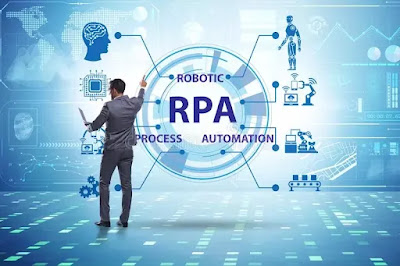
Automating Finance & Accounting Process via Robotic Process Automation (RPA)

Image
  Introduction to RPA Technology: RPA is a technology that enables a robot—the digital worker or a ‘bot’—to execute processes by emulating human interaction with computer applications through the User Interface. In 1959, Arthur Samuel developed Machine Learning (ML), which is one of the most important technologies that eventually led to the creation of RPA. ML allowed computers to perform several critical tasks, such as translation & text summarization, etc. RPA was first coined in the year 2000, however, the foundational technologies on which RPA was built have been around for decades. The foundational technology on which RPA is based are: Screen Scraping; Workflow Automation; Artificial Intelligence. The capability of RPA Technology: RPA has the ability to: Interact with other systems via Screen scraping or API Integration or OCI; Ability to determine actions based on inputs it gathered from other systems; Ability to Report. RPA in Finance & Accounting Process: Mckinsey ...